

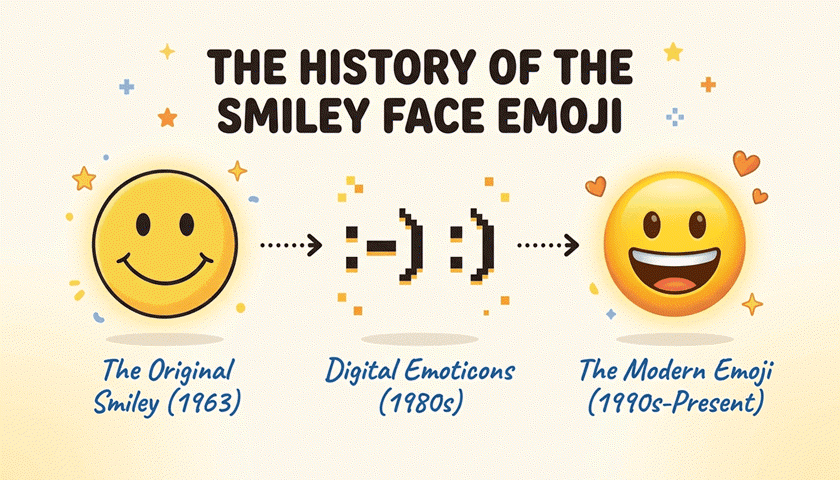
Think about the last time you sent a message without an emoji. It probably felt a little flat, right? In today's world, emojis — especially the humble smiley face — have become as natural a part of our conversations as words themselves. But this tiny yellow circle with a grin has a surprisingly rich and fascinating backstory. Let's take a trip through history to explore how the smiley face went from a hand-drawn doodle to one of the most recognisable symbols on the planet.
It All Started With a Grumpy Office 😐 → 🙂
Believe it or not, the smiley face was born out of a workplace morale crisis. Back in 1963, a mutual insurance company in Massachusetts was going through a rough patch — staff morale was at an all-time low following a merger. So they did what any sensible company would do: they hired an artist to cheer people up.
That artist was Harvey Ross Ball, a commercial graphic designer from Worcester, Massachusetts. His brief was simple — create something that would put a smile on employees' faces. Ball delivered, and in just ten minutes (and for a fee of just $45!), he sketched out a bright yellow circle with two simple dots for eyes and a wide, curving smile.
It was clean. It was friendly. It was impossible not to like. And it worked — employees began wearing it as a pin badge, and morale improved almost immediately. Interestingly, Ball never trademarked his design, which meant it was free for the world to use… and use it they did.
The 70s, Disco, and "Have a Nice Day" 🕺
By the 1970s, the smiley face had taken on a life of its own. Entrepreneurs Bernard and Murray Spain spotted the design and began mass-producing it on everything imaginable — buttons, stickers, t-shirts, posters, mugs, and more. Paired with the era's signature catchphrase "Have a Nice Day," the smiley face became the feel-good emblem of a generation.
The disco era was all about positivity, freedom, and fun, and the smiley face fit perfectly into that vibe. It crossed borders and cultures, appearing in shops and streets across the United States and beyond. What had started as an internal office pick-me-up had become a full-blown cultural icon.
Even as the 70s gave way to the 80s and 90s, the smiley face kept reinventing itself. It was adopted by the rave culture of the late 80s as a symbol of euphoria and togetherness — a meaning that felt surprisingly true to its original spirit.
Enter the Digital World: ASCII Art and Early Emoticons 💻
As computers began entering homes and offices in the 1980s, people quickly discovered a problem: typed text can be surprisingly hard to read emotionally. A joke can look like a complaint. Sarcasm can seem like sincerity. Something needed to fill the gap.
The answer came on 19 September 1982, when computer scientist Scott Fahlman proposed using 🙂 and 🙁 to distinguish humorous posts from serious ones on a Carnegie Mellon University message board. This was the birth of the emoticon as we know it, and the smiley face was at the centre of it all.
From there, early internet users and email writers went wild with ASCII art — using keyboard characters to construct little faces and scenes. These were clunky by today's standards, but they laid the crucial groundwork for what was coming next.
The Emoji Era: Smiley Goes Mainstream 📱
The real game-changer came from Japan in the late 1990s. Shigetaka Kurita, working for Japanese mobile provider NTT DoCoMo, designed a set of 176 small digital icons to make mobile communication more expressive and efficient. These were the very first true emojis — and yes, a smiley face was among them.
When smartphones exploded in popularity during the 2000s, emojis came along for the ride. The Unicode Consortium — the organisation that standardises text characters across devices and platforms — officially adopted emojis into its system, meaning a smiley face sent from an iPhone would look (roughly) the same on an Android or a Windows PC. Suddenly, emojis were everywhere.
Today, the smiley face emoji exists in dozens of variations: grinning, blushing, winking, laughing until it cries, heart-eyes, and more. Apple, Google, Samsung, and others each put their own artistic spin on the design, but the warm, welcoming essence of Harvey Ball's original sketch shines through every single one.
A Universal Language 🌍
One of the most remarkable things about the smiley face emoji is how it transcends language. You don't need to speak English, Mandarin, Spanish, or Arabic to understand what 😊 means. It communicates warmth, friendliness, and goodwill instantly — no translation required.
In a world where we communicate across continents in milliseconds, this kind of universal shorthand is genuinely powerful. Researchers have found that our brains process emoji faces in a similar way to real human faces, which is why they feel so natural and effective in conversation. A smiley face can soften a difficult message, add warmth to a professional email, or simply let someone know you're glad to hear from them.
From a $45 Sketch to Digital Ubiquity
It's quite something to think about: a simple drawing dashed off in ten minutes over 60 years ago is now sent billions of times every single day across the globe. The smiley face has survived every technological shift — print, television, the internet, smartphones — and come out the other side more popular than ever.
So next time you tap that little yellow face before hitting send, spare a thought for Harvey Ball and his cheerful, unassuming circle. It's a tiny symbol with a big heart — a reminder that no matter how complicated the world gets, the desire to connect, to be kind, and to share a little happiness is something we all have in common. 😊