

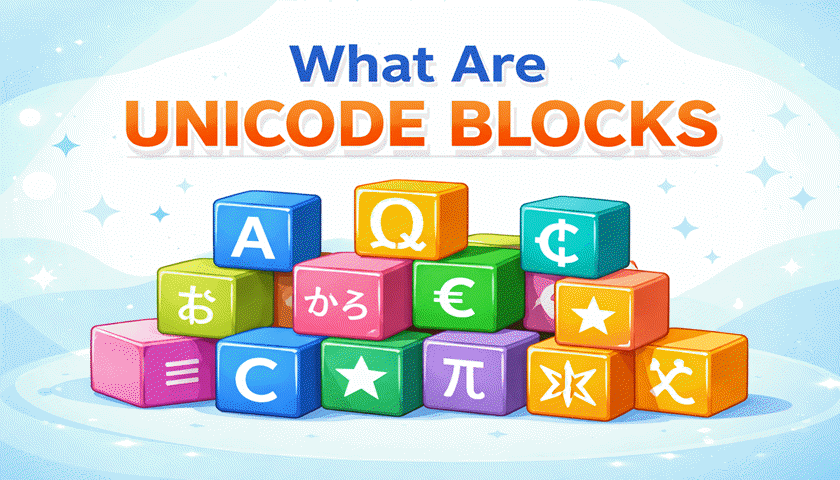
We live in a world where a teenager in Tokyo can send a message to a friend in Brazil, a business in Egypt can share documents with a partner in Germany, and anyone can pepper their texts with emoji — all without a second thought. But have you ever wondered what makes this seamless cross-language communication possible? A big part of the answer lies in something called Unicode, and more specifically, Unicode blocks.
What Is Unicode, Exactly?
Think of Unicode as the internet's universal language dictionary. Before Unicode existed, different computers and operating systems used their own incompatible systems to represent text — meaning a document created on one machine could turn into garbled nonsense on another. Unicode solved this by assigning every character, symbol, letter, and glyph in human writing its own unique ID number, called a code point.
From the letter "A" to Arabic script, from Korean hangul to mathematical symbols, Unicode covers them all under one roof. Today, it defines over 140,000 characters spanning hundreds of the world's writing systems — and it's still growing.
So What Are Unicode Blocks?
With 140,000+ characters to manage, you need a smart way to keep things organised. That's where Unicode blocks come in.
A Unicode block is simply a defined, continuous range of code points grouped together because they belong to the same script, language family, or category. Think of it like a well-organised library: rather than throwing every book into one giant pile, you sort them into sections — fiction, history, science, and so on. Unicode blocks do the same thing for characters.
These groupings aren't random. They're based on linguistic, geographic, or functional relationships, making it far easier for developers, linguists, and everyday software to locate and work with a particular set of characters.
Some Real-World Examples
Here are a few Unicode blocks you've almost certainly used today without knowing it:
-
Basic Latin (U+0000–U+007F) — The everyday characters of English and Western European languages: letters, numbers, punctuation, and common symbols. The character you're reading right now? It lives here.
-
Arabic (U+0600–U+06FF) — This block covers the Arabic script, which is used not just for Arabic itself, but also for Persian, Urdu, and several other languages spread across the Middle East and South Asia.
-
CJK Unified Ideographs (U+4E00–U+9FFF) — "CJK" stands for Chinese, Japanese, and Korean. This block houses thousands of shared ideographic characters used across East Asian writing systems — a fascinating example of how Unicode can bring together related scripts under one umbrella.
-
Emoticons (U+1F600–U+1F64F) — Yes, even 😂 has a formal home in Unicode! This block contains the familiar smiley faces and expressive pictographs that have become a language of their own in digital communication.
Why Do Unicode Blocks Matter?
You might not think about Unicode blocks in your daily life, but they're quietly doing a lot of heavy lifting:
-
They make software development simpler. When a developer is building an app that needs to support, say, Thai or Hebrew, they can focus directly on the relevant Unicode block rather than hunting through the entire character set.
-
They keep data efficient. Grouping similar characters together helps computers encode and transmit text more efficiently, which matters at scale — think of the billions of messages sent every minute across the globe.
-
They champion inclusivity. Unicode blocks ensure that minority languages and lesser-known scripts aren't left out of the digital world. Every language that has a block is a language that can be typed, searched, displayed, and preserved digitally.
-
They enable compatibility. Because the standard is universal, a document created in one country can be opened and read correctly anywhere else in the world, regardless of the device or operating system.
The Bigger Picture
Unicode blocks might seem like a dry, technical topic — but they represent something genuinely remarkable: a global, collaborative effort to make sure every human language has a place in the digital world. The next time you switch your keyboard to another language, drop an emoji into a message, or visit a website written in a script you don't recognise, there's a Unicode block quietly making it all work.
In a sense, Unicode blocks are one of the unsung heroes of the modern internet — organising the beautiful complexity of human language so that technology can bring us all a little closer together.